
The Ministry of Economy (MoE) has signed a Memorandum of Understanding (MoU) with the Dubai Police General Command to improve cooperation in developing compliance mechanisms aimed at combating money laundering and financing of terrorism. This agreement is designed to facilitate the exchange and integration of information between the two entities, thereby strengthening their supervisory roles within the national legislative framework.
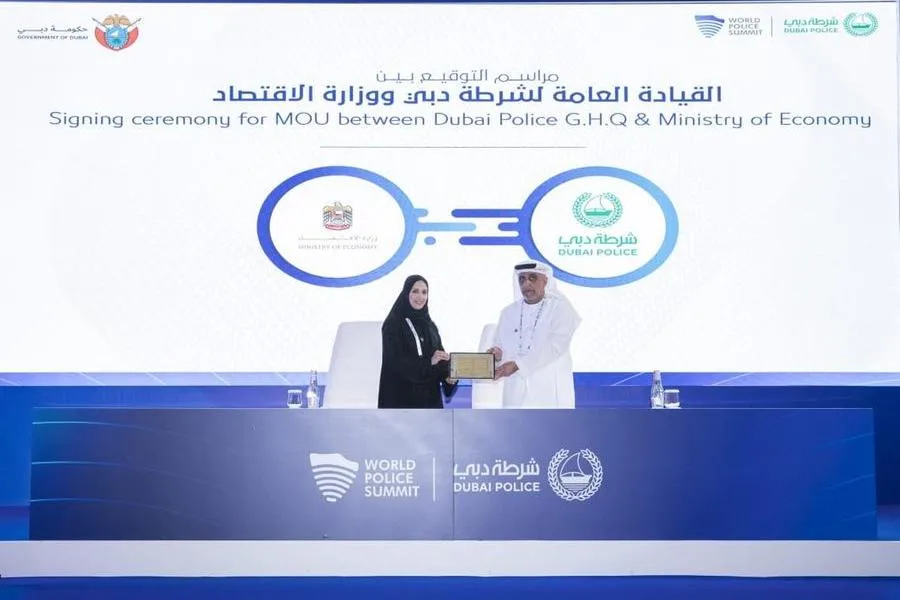
The MoU was formalized during the fourth edition of the World Police Summit, which took place at the Dubai World Trade Centre and was held under the patronage of His Highness Sheikh Mohammed bin Rashid Al Maktoum, Vice President and Prime Minister of the UAE and Ruler of Dubai. The signing was conducted by H.E. Safia Hashim Al Safi, Assistant Undersecretary for Commercial Control and Governance at the Ministry of Economy, and H.E. Major General Expert Khalil Ibrahim Al Mansoori, Assistant Commander-in-Chief for Criminal Investigation Affairs at Dubai Police.
H.E. Safia Al Safi highlighted that the UAE has made notable progress in developing advanced strategies, policies, and legislation to combat financial crimes, aligning with the highest international standards. This advancement has further solidified the national economy’s status as a competitive trade and business hub committed to integrity and transparency. She noted that the partnership with Dubai Police aligns with the Ministry’s vision to enhance collaboration with both federal and local entities, strengthening the national framework and improving mechanisms to combat financial crimes.
The MoU establishes a sustainable institutional framework for the Ministry of Economy and Dubai Police to work together on various procedures related to anti-money laundering and counter-terrorism financing within the UAE. This collaboration aims to enhance the efficiency of control and monitoring systems and serves shared goals in the fight against financial crimes.
H.E. Major General Expert Khalil Al Mansoori remarked that the MoU represents a significant milestone in fostering institutional integration among entities involved in combating financial crimes. He stated that Dubai Police is dedicated to advancing its technical and human capabilities to support national efforts against money laundering and terrorism financing. The aim is to utilize Dubai Police’s resources in research and financial analysis to develop effective mechanisms for detecting suspicious activities and enhancing rapid responses to associated risks, in line with global best practices.
Counselor Salem Al Tunaiji, Director of the Anti-Money Laundering and Counter-Terrorism Financing Department at the Ministry of Economy, explained that the MoU will facilitate advanced technical and security coordination. This includes sharing data related to money laundering and terrorism financing crimes, which aligns with the Ministry’s role in supervising Designated Non-Financial Businesses and Professions (DNFBPs) and identifying the actual beneficial owners of legal entities.
Under the MoU, both parties will work together to create integrated mechanisms and programs to improve responses to suspicious financial activities within the DNFBP sector, which includes real estate agents, brokers, precious metals and stones traders, auditors, and company service providers. This will be achieved through the exchange of data regarding suspicious transactions and activities and by establishing secure communication channels to facilitate the swift exchange of confidential information in accordance with legal and regulatory frameworks.
The MoU also includes plans for joint training programs and specialized workshops aimed at enhancing the professional skills of staff from both parties. Additionally, it calls for the development of periodic analytical reports to support decision-making and ensure thorough application of administrative and regulatory procedures.

Furthermore, the MoU outlines initiatives to support awareness and media campaigns related to institutional compliance and the prevention of financial crimes, as well as collaborations in developing relevant policies and legislation to ensure alignment with international requirements.
Leave a Reply