
On May 4, 2025, the UAE’s Abu Dhabi Ports Group (AD Ports Group) entered into a controversial agreement with Egypt’s General Authority of the Suez Canal Economic Zone (SCZONE) to develop and manage the KEZAD industrial and logistics zone, located near Port Said. This zone covers approximately 20 square kilometers and is strategically positioned at one of the world’s most crucial waterways, the Suez Canal.
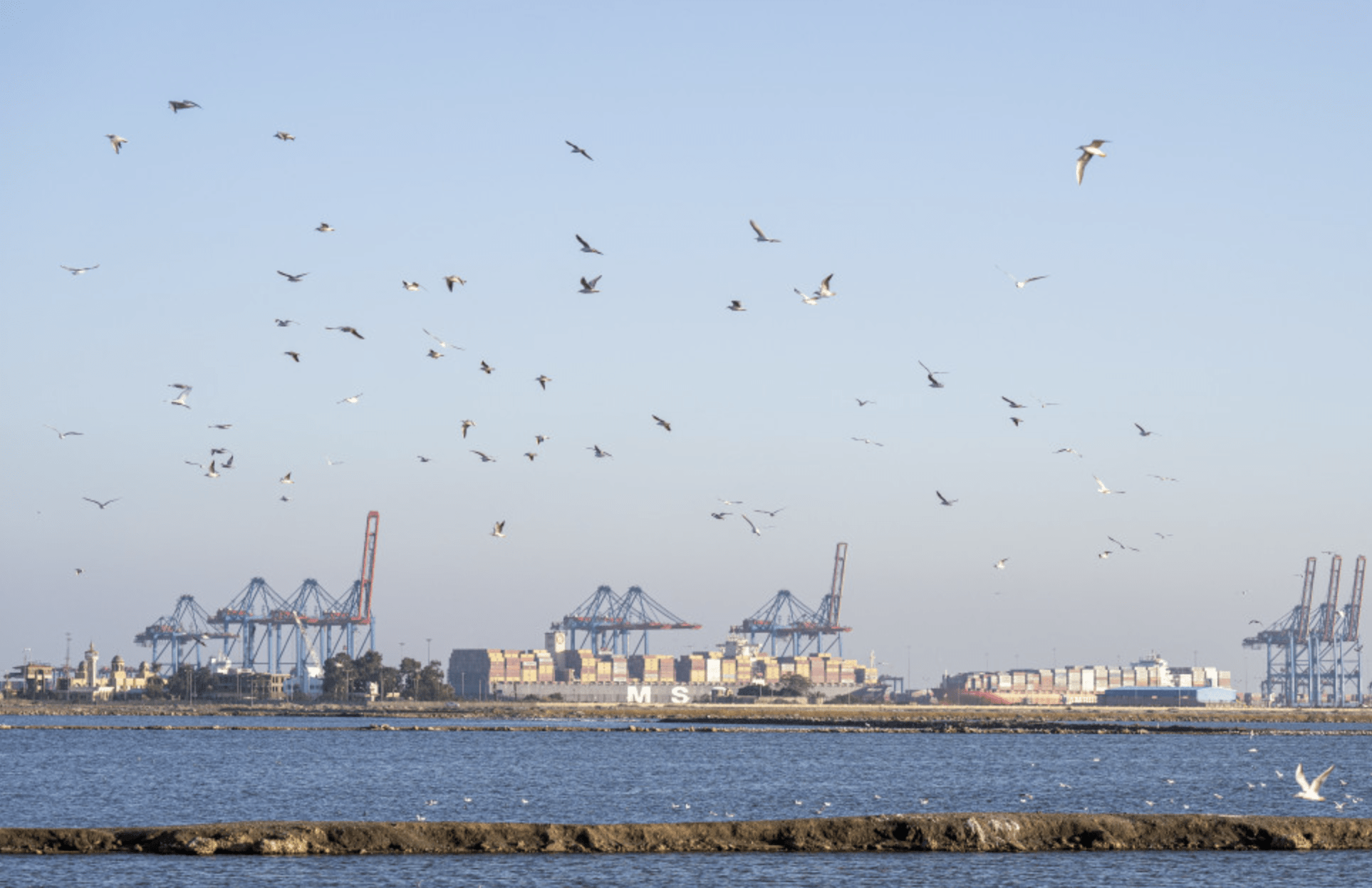
The deal comprises a 50-year renewable land use agreement that paves the way for Emirati investments totaling $120 million in its initial phase. These funds are earmarked for market and technical research, as well as initial development efforts. Under this agreement, Egypt will receive 15 percent of the revenues, although these figures will not be based on net profits, raising concerns about the deal’s fairness and implications for Egypt’s economic interests.
The recent agreement has ignited questions surrounding its strategic importance, economic viability for Egypt, and the long-term consequences of further Emirati control, especially given the UAE’s extensive investment history in Egyptian ports. Critics argue that this trend may compromise Egypt’s national and economic security.
The UAE’s influence in Egypt’s port sector has steadily increased over the past two decades. Currently, Dubai Port World (DP World) holds a 90 percent stake in Ain Sokhna Port, a 32 percent stake in Alexandria Port, and a 49 percent stake in various projects under the Suez Canal Authority (SCA). This growing control has raised concerns as some experts note a perceived failure to advance these ports, seemingly favoring the UAE’s free zones, particularly Jebel Ali.
For instance, Ain Sokhna Port, initially designed to accommodate five million containers annually, has stagnated at a capacity of only 250,000 containers for the past 25 years. This stagnation prompts valid questions regarding the commitment of Emirati investors to their contractual obligations and Egypt’s ability to enforce terms effectively.
The agreement to develop the KEZAD East Port Said Industrial and Logistics Zone unfolds against a backdrop of heightened scrutiny. Under this contract, AD Ports Group gains operational control over a critical area at the Suez Canal’s entrance, yet lacks binding commitments for achieving specific growth targets or development milestones.
Economist Ahmed Khuzaim expressed his apprehension about the contract’s framework, remarking to Al-Araby Al-Jadeed that granting operational rights to a foreign entity without an international bidding process effectively undermines Egypt’s sovereignty over a vital economic asset. Khuzaim argued that if the project had been subjected to international tender, it could have generated upwards of $40 billion for Egypt throughout its duration.
“The most dangerous aspect is that the revenues Egypt will receive do not exceed 15 percent,” he emphasized. He further pointed out that this percentage is not based on net profit, allowing for potential manipulation of financial statements by companies to minimize declared profits.
Amidst these concerns, there is speculation about the UAE’s intentions, particularly against the backdrop of geopolitical tensions surrounding the Suez Canal. Sources indicate that while China showed interest in securing concessions at Ain Sokhna port, U.S. pressure thwarted such negotiations, driven by fears of Chinese presence at the canal’s entrance.
Furthermore, plans for a Russian industrial zone within the East Port Said area remain stalled, with no construction progress reported despite over three years since their announcement. Observers note that foreign interference may be hindering the entry of unwanted actors, according to project sources.
Concerns about the lack of transparency surrounding the agreement have also been raised by Egyptian academic and economics professor Ahmed Zekrallah. He criticized the absence of parliamentary discussion regarding the deal and highlighted recent laws that prevent legal challenges to such agreements. Zekrallah questioned how Egypt could surrender control of a strategically significant area under a 50-year contract without explicit guarantees or termination clauses for non-compliance.
Zekrallah stressed that Egypt could have enforced stringent penalties for non-compliance and established deadlines for implementation instead of relying solely on investor discretion. He also expressed skepticism regarding the absence of competitive bids from other nations, such as China and France, suggesting geopolitical factors may be overshadowing Egypt’s economic priorities.
Conversely, economic expert Tarek Metwally argues that the project offers substantial benefits for Egypt amid challenging economic conditions. He noted that the cost to create a single job in Egypt exceeds EGP 300 000 ($6 000), whereas the Emirati deal promises thousands of new jobs, alongside tax revenue and social contributions.
“The global landscape is fiercely competitive for investment,” Metwally stated, advocating that Egypt’s engagement in such a contract is a positive step, especially given the current inadequacies in infrastructure and regulations that deter international investors. Nonetheless, he acknowledged the necessity for strict oversight to ensure compliance and protect Egyptian interests through transparent mechanisms.
On the national security front, strategic expert Colonel Hatem Saber believes concerns about Emirati investments in Egyptian ports are overstated. He asserts that the construction site will remain entirely Egyptian territory and that the contract, based on land use rather than ownership, does not compromise Egypt’s sovereignty. Saber further downplayed the significance of the India-Middle East-Europe Economic Corridor (IMEC), noting that the logistical demands for unloading a single ship in this corridor render it economically impractical compared to the Suez Canal.
This article is sourced from Al-Araby Al Jadeed, mirroring its original editorial guidelines and reporting policies. For additional information or inquiries, please reach out to the original authors or editors.
Leave a Reply