
The United Arab Emirates will begin teaching Artificial Intelligence to public school students from kindergarten through grade 12 starting in the 2025-26 academic year. This significant initiative was announced by His Highness Sheikh Mohammed bin Rashid Al Maktoum, the Vice President and Prime Minister of the UAE and Ruler of Dubai, as part of the country’s long-term strategy to prepare future generations for a rapidly changing world.
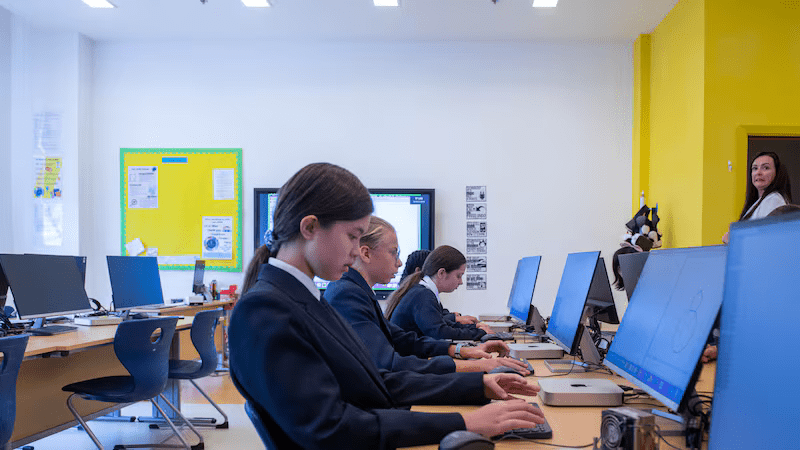
The introduction of AI into the school curriculum aims to equip students with essential knowledge and skills needed to understand AI concepts and apply them in their daily lives. This program aligns with the UAE’s commitment to empowering youth to adapt to global trends and drive innovation, positioning the nation among the first to integrate AI into educational frameworks.
Sarah bint Yousef Al Amiri, the Minister of Education, stated that the new AI curriculum will seamlessly fit into existing school schedules without requiring additional class time. The curriculum will consist of age-appropriate learning modules delivered by designated teachers within the Computing, Creative Design, and Innovation subject.
The curriculum will cover seven key areas, including data and algorithms, software applications, ethical awareness in AI, real-world AI applications, AI-driven innovation and project design, as well as AI policies and social engagement. Comprehensive resources will be provided by the Ministry of Education, including activities, templates, and ready-to-use lesson plans that can be adapted to various classroom settings.
Sheikh Mohammed emphasized the goal of the curriculum is to foster a deep understanding of AI among students from a technical perspective while also instilling awareness of the ethical implications of this technology. He expressed the responsibility to prepare children for a future characterized by different conditions and the need for new skills and capabilities that will sustain the UAE’s development and progress for years to come.

The AI lessons will be tailored to different age groups, starting with kindergarten where children will engage in visual and interactive activities related to AI and digital technologies through stories and play. In Cycle 1, students will learn to compare machines to humans and develop digital thinking skills. Cycle 2 will focus on designing and evaluating AI systems, teaching students about bias and algorithms, as well as ethical AI use. Finally, Cycle 3 will prepare students for higher education and careers by simulating real-world scenarios and teaching command engineering.
Leave a Reply