
A significant private sector partnership is set to advance the UAE’s ambitions in the global space race by developing reusable rockets. Aspire Space, a European aerospace company, is moving its headquarters to the Emirates and collaborating with Dubai-based Leap 71 to create a two-stage rocket system. This vehicle is intended to transport up to 15 tonnes to low-Earth orbit, with its inaugural launch planned for 2030.
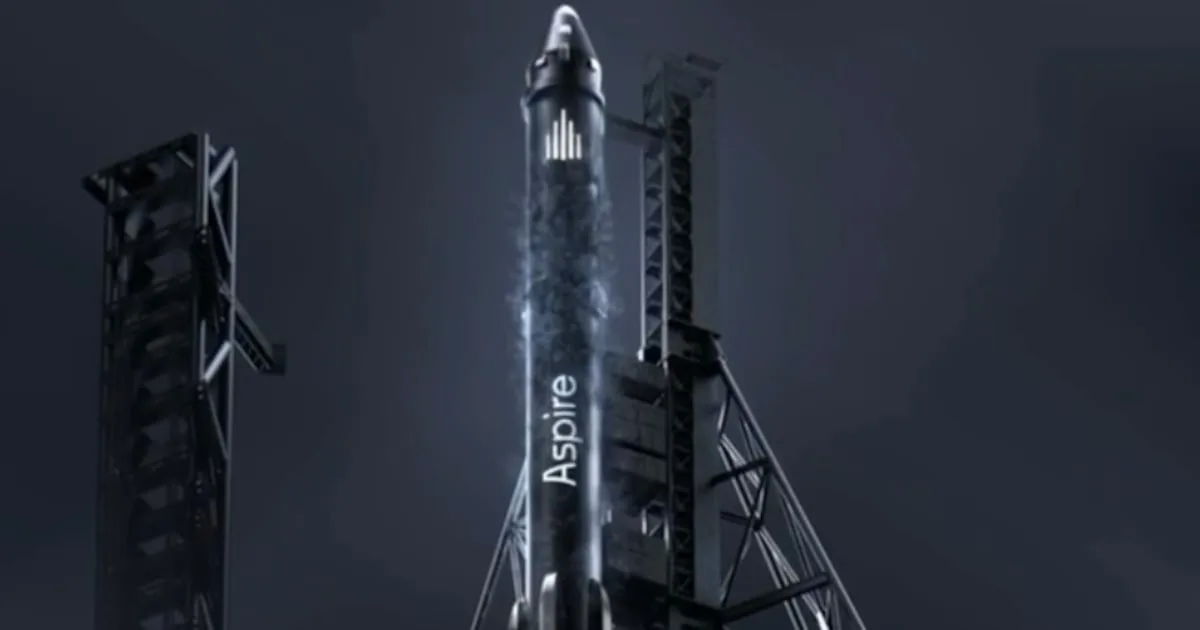
This agreement is pivotal for the UAE as it seeks to establish sovereign access to space, a capability currently held by only a few nations, including the US, Russia, Europe, and China. Stan Rudenko, the chief executive of Aspire, emphasized the ambitious timeline, stating, “We are planning the first launch in 2030, and I would say that it’s a very ambitious timeline.” He highlighted the importance of partnering with experts in propulsion systems for the project.
The rocket will be powered by Methalox engines, which utilize liquid methane and liquid oxygen. These engines are designed and developed by Leap 71, incorporating artificial intelligence, and will be manufactured entirely in the UAE. While a specific launch site has not yet been determined, Lin Kayser, co-founder of Leap 71, mentioned that Oman presents a promising option due to its developing Etlaq spaceport, located a 10-hour drive from Dubai.
Oman is already conducting test launches from the site, with commercial operations expected to begin later this decade. “Oman has a fantastic place for launching rockets,” Kayser noted, suggesting that building the rockets and engines in the UAE while launching from Oman could be a strategic approach.
The UAE has made substantial strides in space exploration, including sending astronauts to the International Space Station and launching a probe to Mars. However, a critical capability still lacking is the ability to conduct its own missions with domestically built rockets. Kayser pointed out, “Any region that wants to participate in the space economy fundamentally needs sovereign access to space, because otherwise you’re always relying on someone else.” He underscored the challenges faced by global tech giants who depend on foreign launch providers.
Leap 71 is currently designing the propulsion systems for Aspire’s reusable rocket, based on its XRB-2E6 engine, which generates 2,000 kilonewtons of thrust. The development process employs Noyron, an artificial intelligence model that can autonomously generate rocket engines and manage their operational parameters. Kayser stated, “Our proposition, as Leap 71, is if we build propulsion systems, then launcher companies will come here.”
He explained that acquiring propulsion systems on the free market outside the United States is nearly impossible. This model mirrors the aerospace industry, where companies like Boeing and Airbus produce airframes while GE and Rolls-Royce manufacture engines. Leap 71 has validated its technology with smaller engines and is now transitioning to larger systems required for orbital rockets.
However, developing and testing large rocket engines necessitates specialized facilities. Kayser explained the impracticality of transporting these engines across borders due to export restrictions, stating, “You have to produce them here … it’s not like you can just ship them around the world.” This strategy ensures that the entire rocket development process, from design to testing and manufacturing, remains within the UAE.

Founded in 2023 in Luxembourg, Aspire was established by engineers with extensive experience in developing major launch systems, including the Soviet-era Zenit and Soyuz programs. The company plans to expand its team by hiring 20 new employees, including rocket scientists, in the UAE. Additionally, Aspire aims to develop a reusable capsule to transport cargo and, eventually, humans to space stations.
Leave a Reply